
Tag Archives: Leadership
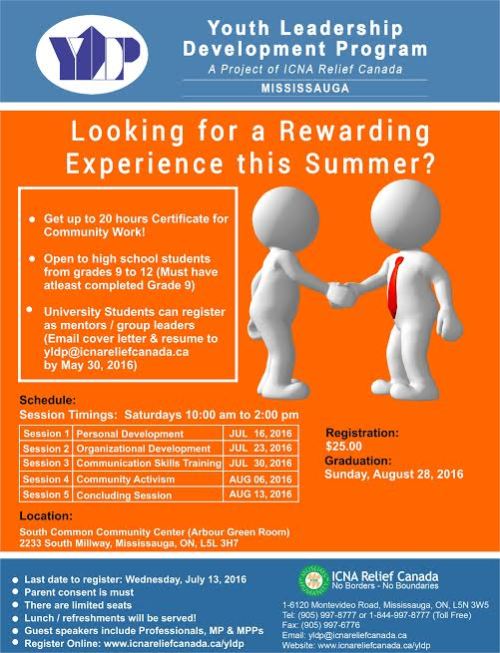
Event Presentation: “Organizational Development” by Taha Ghayyur (Jul. 23, 2016)
Interview with Taha Ghayyur: Leadership in Action!

By Seema Khan at ISNA Lanterns
When sitting across Taha Ghayyur, you would never be able to guess that beneath his humble and confident exterior lives a dynamic combination of creativity and intelligence. Taha personifies the new generation of young Muslims who have made their mark as professionals, and continue to make a difference for Muslims living in Canada.
His teenage years are of a typical young Muslim in Canada navigating their way toward a confident identity that is rooted in Canadian values and faithful to their religious traditions. What he took away from his life experiences laid the foundations for his ambition. After graduating from the University of Toronto in Religious Studies and Marketing, Taha embarked on an information technology career during the booming “dot com” era, which paved the way for his future work with the Muslim community.
Taha Ghayyur’s resume shows his incredible talents and accomplishments. If you’re a Muslim living in the GTA, it’s highly likely you have been impacted or influenced by some of Taha’s impressive work. He’s been a chairperson for MuslimFest, an annual festival showcasing Muslim art and commerce, helping set precedence for such a gathering in the GTA. He has engaged the Muslim community through an online weekly publication, of which he was the founding editor. Since 1999, the publication has sought to inspire and advise youth around the world on contemporary lifestyle issues with Islamic literature.
But Taha’s career truly took off in 2005, when he accepted the position of Development Manager with Sound Vision (www.SoundVision.com), a pioneering Islamic media organization in North America. Since then, he has also been the Managing Editor of the company website and online newsletters. He is involved with production of the world renowned Adam’s World videos, a flagship Sound Vision production for children.
On top of all this, Taha serves as a volunteer on the board of DawaNet, a powerhouse not-for-profit organization in Canada focusing on Muslim empowerment, engagement, and education. DawaNet is responsible for the Torontomuslims.com portal, the Understanding Islam Academy, MuslimFest, MY Voice and the Canada Zakat project.
Taha is an incredibly talented young man, a well-known writer, public speaker, community organizer and marketing consultant. When I sat down in conversation with him, Taha explained his vision of combining creativity and spirituality. “The end goal has always been to be involved in making Islam accessible, affordable and socially relevant at a local, national and international level,” he said.
When asked what kind of advice he would give to Muslim youth seeking employment and career direction, Taha immediately noted that, “Young people can bring about incredible changes by being more vibrant and engaged. We need to have positive minds, and be purpose-driven to serve the wider community in a variety of ways and professions. They need a holistic attitude to Islam and to the society they are living in. One should not be reactionary and quit work to focus just on Islamic work but rather create a balance between being a professional and a dedicated volunteer. ” He explained that in the times of the Prophet (S.A.W.), most of the companions specialised in serving all areas of society while very few specialised in Islamic knowledge. “Be servants first and then leaders,” said Taha, “roll up your sleeves for work and Allah will grow you in ways that you can’t imagine. Acknowledge that we need specialists, writers, counsellors, project managers. Professionals who are willing to give back to the community as volunteers.”
Taha has researched and is well informed on the future growth and potential of the Muslim demographics in Canada. “As our population in Canada grows, our leaders, institutions, and thinkers need to focus on youth engagement, collaborative leadership, better social services, civic engagement and creative Dawah efforts,” Taha advised. “We also need to build vibrant institutions for Islamic presence, rather than building a personal brand and following.”
Taha has proven to be a strong leader without a boisterous exterior. After an incredible conversation with someone who has given so much to our community, I walked away feeling humbled to the fact that Taha Ghayyur has been the backbone of many leading Muslim ventures. Yet he remains unnoticed, only because the focus of his work has always been for his community, and never for himself.
Being a father of three young children, Taha hopes that the next generation of Canadian Muslims will contribute even more to Islam and Canada. He has given practical meaning to his ideals for having a purpose-driven career and by giving back to his community in creative ways.
Filed under Media
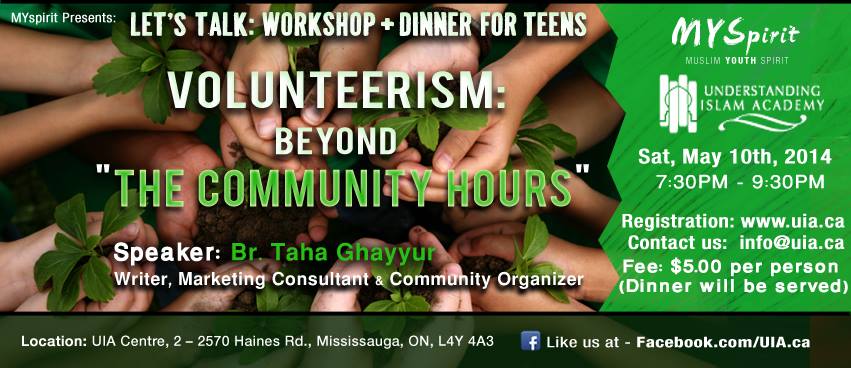
Event Presentation: “Volunteerism: Beyond The Community Hours” with Br. Taha Ghayyur on May 10, 2014
From Slavery to Leadership: Muslims in North America
By Taha Ghayyur
Malcolm X, Muhammad Ali, and Jameel Al-Ameen are perhaps a few names that cross our minds when we consider the evolution of Muslim identity and community in North America. What often escapes notice is the sacrifice, discipline, social justice, leadership, and cooperation modeled by such individuals and their communities.
The organized struggle of North American Muslims begins over seven centuries ago with the civil rights movement led by multitudes of Muslim African slaves. The spirit and movement continues today with the millions of Arab and South Asian Muslim immigrants, as well as the Latin and First Nations indigenous Muslim converts in North America.
Keeping Faith Alive in the ‘New World’
In the story of early African American Muslims, we find fascinating and empowering historical events. The story of Job ibn Solomon Jallo, in the early 1700’s, who was a well-mannered, intelligent, literate trader and Imam, reminds us of the Quranic and Biblical story of Prophet Yaqoob’s (Job) life. Captured in Gambia, Job wrote out three copies of the entire Quran from memory. He was later freed and reunited with his loving son and family[i].
The account of Bilali Muhammad (Ben Ali), an African scholar in the early 1800’s, captivates many as we read about the vibrant Islamic community he built in Georgia, as a slave[ii]. His determination to hold on to Islamic principles, regardless of his circumstances, inspires awe and admiration. In many ways his life parallels the life of Bilal Ibn Rabah, an early African slave convert to Islam in Makkah.
As Amir Nashid Ali Muhammad explains in Muslims in America: Seven Centuries of History (1312-1998):
In the ‘New World’, some of the African slaves suffered doubly tragic fate. Initially, they were enslaved because they were African, but when it was discovered that they were also Muslims, their suffering was compounded. They were tortured, burned alive, hung, and shot unless they renounced their religion and their names. At least 20% of the Africans brought to the U.S. were Muslims from ….the coastal and interior regions of the Islamic empires of Songhai, Ghana, and Mali.[iii]
Early Muslim Participation in America
We discover with pride that there were Muslims, who, in the War of 1812, helped defend America against the British[iv]. In a lecture held at Concordia University, Montreal, Imam Khalid Griggs, a political activist and leader of a North Carolina mosque, highlighted the role Africans played in the American Civil War. He related the stirring account of one African Muslim named Mohammad Ali Ibn Said, who moved to the U.S. from Africa to volunteer for the all-Black 55th division:
“Mohammad Ali said, ‘I do not want to just sit back and not do anything, I want to do something to help my brothers. The blood that joins me is deeper and stronger than the water that separates me from Africa to the United States,’…So he chose to come into a slave country at a time when he was risking his own freedom.” [v]
Did You know?
- The first person to request the freedom of all slaves in America was a Muslim.
- Muslims fought in many of the early wars.
- Muslims were known to live in at least 7 of the 13 original colonies, including Connecticut, New York, Massachusetts, Maryland, South Carolina, North Carolina, and Georgia.
- The early American Muslims have contributed many Arabic words found in English today, such as, admiral, algebra, atlas, banana, cable, camel, checkmate, coffee, cotton, jasmine, lemon, magazine, mask, rice, sofa, sugar, syrup, and zero to name a few.
- Columbus was not the first adventurer to travel from Europe to the Americas. Around 986 AD, Moors (people from North Africa) crossed the Atlantic Ocean in ships, bringing back with them people from the new world.
Sadly, the impact of Black, African, and Muslim cultures on world history is often neglected in historical discourse. There are pages of history which tend to get ripped out.
Towards Contribution & Leadership
While, it could be argued that faith in today’s secular world is receding to the private quarters, North American Islam is manifesting itself as an urban phenomenon. Dr. Tariq Ramadan, a professor of Philosophy at the College of Geneva, in his monumental study, To be a European Muslim, reminds us of our role and responsibility in the secular context today. He explains:
At this time of globalisation and internationalisation, when all nations are subject to a new world order which denies or forgets God,…based on an exclusive economic logic, Muslims are facing the same responsibilities… Assertive and confident, they have to remind people around them of God, of spirituality and, regarding social affairs, to work for values and ethics, justice and solidarity. They do not forget their environment but, on the contrary, once in security, they should influence it in positive way.[vi]
Contemporary North American Muslims possess a rich seven-century old legacy of dedication, activism, community empowerment, justice, peace, and tolerance, inherited from their Muslim forefathers in this land. They must now change their outlook from the reality of “protection” alone to that of an authentic “contribution” to the society. It is at this unique juncture of Islamic history, constituting the largest and most diverse Muslim minority that we need to study the contribution of African American Muslims as the models that produced the great leaders we long for today.
Endnotes:
[i] Amir Nashid Ali Muhammad, Muslims in America: Seven Centuries of History, (Beltsville, MD: Amana Publications, 1998), 11.
[ii] A. Muhammad, Muslims in America xi.
[iii] A. Muhammad, Muslims in America, xiii.
[iv] A. Muhammad, Muslims in America, xi.
[v] The McGill Daily, Issue 46.
[vi] Tariq Ramadan, To Be A European Muslim(Markfield, Leicester: The Islamic Foundation, 1999), 144-145.
Also Re-published in The Muslim Voice (University of Toronto MSA)
Filed under American Muslims, Leadership
 MyInkspiration