
Tag Archives: Taha Ghayyur
Khutba: “What can I Do for War-Torn People” by Taha Ghayyur
Filed under Community, Khutba & Lectures
13 Reasons Young Muslims Fall Prey to Radicalization

By Taha Ghayyur
While leading and mentoring Muslim youth in a Toronto suburb pre-and-post-9/11, I could understand how easy it was to fall prey to extremist rhetoric and radical ideology – especially for the young and unschooled in basic Islamic teachings.
I remember the urgent, passionate calls to do “something” about the wars being waged by some Western countries in the name of “liberation” and “democracy” in Muslim countries.
I recall the logical arguments being presented for the revival of Khilafa, a central legitimate Muslim leadership, to fix the mess in the Muslim world.
I can still vividly remember the images of a utopian Muslim society depicted by these speakers – a blissful state free of anxieties, immorality, and the social ills of the West.
It all seemed real, achievable, attractive, and fair from the perspective of a concerned, idealistic young Muslim growing up in an increasingly polarized world.
As I was helping young Muslims navigate the tumultuous debates and the cacophony of calls to action, I was struggling to make sense of it all myself. These were indeed trying times. Times of Fitnah.
But the solution was not violence and extremism being aroused by these misguided “leaders”. Change took wisdom, time, and patience – something these preachers never discussed – something Prophet Muhammad, peace and blessings be upon him, routinely taught and practiced.
Thank God, I was blessed with wise parents and incredible mentors and teachers, whose intellectual depth and visionary leadership helped me shape an independent response to such divisive rhetoric. As I witnessed some younger Muslims being torn between the ideals of their faith and loyalty to their citizenship, I was spared such anxiety.
I was confident in declaring to myself and to others that I am Muslim first and I am Canadian first. There is no need for a superficial dichotomy over terms that refer to two distinct aspects of my life as a Canadian Muslim. Religious and secular extremists love to play on these terms and confuse vulnerable youth with the language of “loyalty”, “fidelity”, and “priority”.
I was deeply grounded in and faithful to my Islamic tradition, as well as to the civic duties of my country, Canada. I realized that to be faithful to my Deen and Islamic lifestyle, I did not have to disconnect myself from serving my country and humanity. In fact, the opposite was true. Similarly, a genuine concern for Canada didn’t mean we couldn’t be critical of the government’s domestic politics and foreign policies.
I was able to liberate myself in my early teens from the street theology of “Islam vs. West”, “Muslims vs. America”, and “Khilafah vs. Secular Liberal Democracy”. I was able to free myself from the shackles of both the soft extremism and the violent extremism that are plaguing some young Muslims around the world.
Moreover, I was able to help other struggling young Muslims see the bigger, colourful picture, past the binary vision of the world, a black and white one of constant conflict, wars, and hate painted by extremists in our communities and outside.
Looking back, as I have focused my work on community development and youth leadership, I have contemplated the real sources of radicalization.
Numerous so-called anti-terrorism pundits and experts have debated and proposed potential causes of violent extremism by young Muslims and convert Muslims from the U.S., Canada, and Europe. However, most analyses fail to address the real, at times basic, roots that we can control at the grassroots level.
13 Sources of Radicalization to Consider
1. Lack of courage to admit that extremism of all forms exists in the Muslim community. The idea that by condemning Muslim extremists and terrorists, we are somehow downplaying the pain and atrocities inflicted upon the war-torn Muslim countries, is very disturbing. Many in our community are still in a state of denial that some Muslims would ever commit crimes against humanity. We can’t tackle an issue if it’s not identified as a problem to begin with.
2. Lack of understanding of what a sound “Muslim identity” means. The gross misunderstanding around the issue of loyalty to one’s faith versus loyalty to one’s country is perhaps the stepping stone to extremism.
3. Lack of clarity on terminologies that are hijacked by extremists on all sides, dressed with their own particular nuances: “extremist Muslim”, “moderate Muslim”, “Wahabi Muslim”, “secular Muslim”, “fundamentalist”, “Islamist”, “Sufi”, “Salafi”, “Khilafah”, “Jihad”, “Wilayah”, and the list is endless. One of the basic rules of logic is to have clearly defined terms for an argument to be valid. With confusion surrounding these words that are thrown around so conveniently, often with the help of media, some misguided young Muslims get caught up in one side of the argument – without an in-depth study of the implications of these terms historically and in the contemporary context.
4. Inadequate legitimate, qualified scholarship nurtured and cultured in the North American context that is able to confidently articulate the Islamic position on contemporary crises. Lack of genuine Islamic authority that is firmly rooted in authentic Islamic tradition and is fully aware of its civic duties to its home country, gives opportunity to voices that are on the edge, and often louder and more tech-savvy.
5. Lack of balanced discourse on social justice in the Muslim community. While traditionally, Muslims have a strong, pragmatic social justice narrative, Muslim leaders and Imams have failed to address the issue of social justice in a wholesome manner that reflects the reality of a multicultural neighborhood and an increasingly globalized, interconnected world. Our conversation has to go beyond simply condemning wars in Muslim lands or condemning a terrorist attack by radicals in the name of Islam. It has to condemn the evil trio: War-Terrorism-Islamophobia. All three need to be condemned simultaneously and unequivocally. Our narrative has to offer real solutions for this global crisis, beyond theory. In the absence of such balanced, scholarly discourse, young Muslims are bound to pick sides in the “war on Islam”.
6. Lack of avenues for positive engagement for young Muslims. Due to insufficient quality programs and services that are engaging, inspiring, and relevant, offered by legitimate Muslim institutions, Muslim youth are prone to be attracted to shady “Shaykhs” and YouTube videos that offer a concrete “plan of action NOW”. Art, cultural enrichment, and creative expression are proven tools for keeping youth off the streets and for channeling their energies in a constructive way.
7. Genuine grievances of young Muslims unacknowledged and ignored by media, parents, teachers, Imams, youth leaders, and social service providers in the Muslim community. If we don’t listen to and address the sincere concerns and anxieties of our youth regarding the ongoing atrocities, destruction, and war crimes being committed against their Muslim brothers and sisters around the world, they will naturally gravitate toward those who not only acknowledge their grievances, but also offer “solutions” to the dilemmas of the Ummah.
8. Genuine zeal to practice Islam, which often leads mature, thinking Muslims to limits that are deemed unacceptable by the Prophetic tradition. Prophet Muhammad, peace and blessings be upon him, warned his Companions against any form of extremism in religious practices and rituals whenever he found an opportunity. Numerous traditions of the Prophet exhort us to avoid extremes in prolonged fasting, Quran recitation, the night prayer, and abstinence from physical relations with one’s spouse. He feared that such extreme ritual practice would eventually lead to exhaustion, boredom, and harm to one’s own spirituality, as well as to the rights of others.
9. Natural need for a sense of belonging. Many disenfranchised young Muslims and recently converted Muslims fall prey to the strong affiliation, fraternity, and empowerment that extremist cults offer. The idea that you belong to an exclusive, secretive gang with a peculiar uniform or outlook, and a lofty mission against the evil forces of the world, can be enticing.
10. Inadequate positive role models for Muslim youth who are achievers in this world and the Next. There is a dire need for young professionals and leaders who are caring, compassionate, and sincere in their concern for the success of Muslim youth to mentor and guide them through the most critical phases of their cognitive, social, and spiritual development.
11. Tolerance for intolerance in the Muslim community. While I don’t see this being a rampant problem, extremist ideologies and voices do exist in our community that brainwash and disenfranchise young Muslims. It may not be the violent form of extremism, but the soft version that promotes intolerance toward variant ideological paradigms in Islam, as well as other faith communities. It could be intolerance toward women’s participation in Masjids, leadership, or in the public sphere. It could be intolerance toward authorities, including parents, teachers, Imams, law enforcement agencies, or the government. All of these are symptomatic of radical thinking and behavior. Note: Intolerance is not the same thing as disagreement or protest in a civil manner.
12. The lone wolf phenomenon. A high percentage of acts of terrorism in Canada and the USA are committed by deranged lunatics with known mental health issues and a history of drugs and sex crimes. Such individuals, usually recent young converts to Islam, live in isolation; if they do at all attend a mosque, they are quickly ostracized by the institutions and the community at large. As a community, we need to first acknowledge that mental health problems are on a sharp rise among young Muslims and we need to effectively identify, assess, and refer such cases early on to social service providers and psychiatrists.
Secondly, we need to embrace, accommodate, and integrate young Muslims and converts in our community centres and mosques so they can become full members of the Muslim community. However, at the same time, we need to be vigilant over their activities if they have a history of mental illness and/or crimes. Any expressions of soft extremism or violent radicalization should be noted and reported immediately to law enforcement authorities.
13. Entrapment by government agencies. While the FBI and CSIS must protect their countries, governments, and citizens, they have at times crossed the legal limits of information-seeking. They have instead entrapped naive youth into terrorist activities. This is no secret. Such abuses of power happen everywhere and they need to acknowledged and addressed.
As long as the deadly trio of War-Terrorism-Islamophobia is alive and thriving, we can expect more of the ISIS, Al-Qaeda, and Taliban-style of extremism to flourish. While we cannot control such “external” sources of youth radicalization, we can minimize the damage by managing and monitoring the “internal” sources that we have control over as listed above.
I am thankful to God, our Guide, Nourisher, and Protector, for guiding me at a young age, to a sound, balanced understanding of my faith and of my role in this ever chaotic and violent world.
However, I hope that as stakeholders in the development of young Muslims growing up in North America, we take our responsibility to raise confident, caring, and contributing young adults, more seriously. I truly believe, with concerted effort on the part of our families and Islamic institutions, we will be able to empower and equip young Muslims with a balanced understanding of Islam, a strong faith that is rooted in Islamic tradition, a sincere commitment to their civic duties to their country, and a desire to serve God and His creation.
For more practical tips on fighting extremism in the Muslim community, please refer to:
9 Things Muslim Communities Can Do To Curb Muslim Youth Extremism (Imam Abdul Malik Mujahid)
9 Things Muslim Families Can Do to Curb Muslim Youth Extremism (Samana Siddiqui)
============
Taha Ghayyur is a writer, public speaker, community organizer, and communications and leadership trainer in Toronto, Canada. He works as the Director of Communications with Sound Vision, a pioneer in Islamic media and public relations in North America. He writes and speaks extensively on issues related to Muslim youth engagement, leadership, communication, personal development and community development.
Filed under Muslim Youth
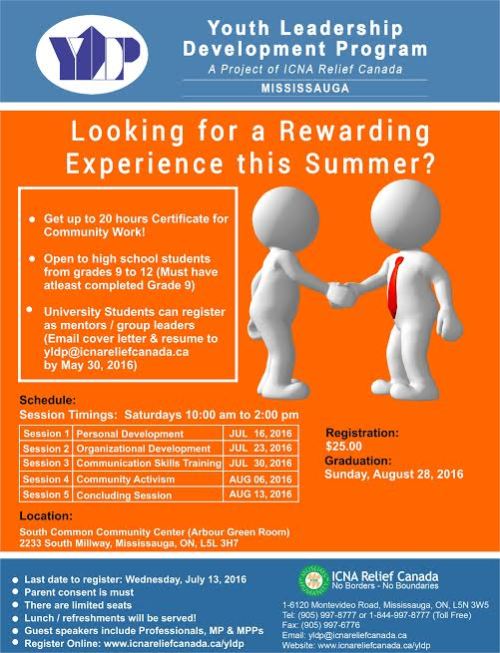
Event Presentation: “Organizational Development” by Taha Ghayyur (Jul. 23, 2016)
12 Ways to Care for Loved Ones with Depression

Support. Care. Understanding.
These are the most powerful ways that you can personally assist a person suffering with depression, which is perhaps the most misunderstood mental health problem in our community. Too often, family members and friends either neglect or don’t realize how critical their care and support are to their loved one who is experiencing depression.
Depression is an insidious condition that affects 1 in 10 Americans at one point in life. Approximately 8% of adults in Canada will experience major depression at some time in their lives. Over 121 million people globally suffer from some form of depression.
Thanks to the rising Islamophobia and anti-Muslim sentiments in media, politics, and institutions, depression is certainly on the rise among Muslims living in the West. One Yale University survey found that about 50% of all Arab-Americans surveyed had clinical signs of depression.
Signs and symptoms of depression vary from person to person. While professional counselling and medical intervention are highly recommended for cases involving serious or chronic forms of clinical depression, there is a lot you can do to ease the situation that your loved one is going through.
- Understand depression. Acknowledge that depression is a mental health problem. Given the taboo surrounding depression and mental health issues in the Muslim community, hardly anyone talks about depression. It is easy to treat depression as just a temporary emotional imbalance or a spiritual problem. You need to spend some time learning about the symptoms and possible remedies involving depression.
- Be there physically. Show that you are there to help your loved one go through this difficult period together. Acknowledge the seriousness of the individual’s condition and offer full support. Don’t belittle their pain. Be there to hug. Be there to show how much he or she means to you and to others.
- Simply listen. Active listening is an art that requires practice. A depressed individual may not be interested in lengthy advice from you. Simply taking the time to listen to and acknowledge his or her problems and concern brings a world of psychological relief.
- Try doing something out of routine. Surprise your loved one with gestures of love. If he or she feels comfortable, go out for a dinner, exercise together, take a stroll in the park, invite some intimate friends over, give a bouquet of flowers, or write a heart-felt card to express your love. Try different things on weekly basis to cheer up your loved one, but be careful not to overdo it.
- Show the bigger picture. Remind your loved one that things will get better sooner or later, God-Willing. “Surely, after hardship comes ease” (Quran 94:6). This is Allah’s promise. Sunshine is on the horizon as the dark clouds of sadness and depression move on.
- Be patient and don’t be judgemental. It is easy to get annoyed with a depressed family member or a friend and lose patience after a few days. A depressed individual often lacks energy and may find doing basic tasks difficult. He or she will test your fortitude and temper. Be ready for a range of mood swings. Do your best to remain calm and non-judgemental.
- Advise to limit bad news, and news in general. Majority of the local, national, international is bad news these days. Killing, accident, robbery, war, terrorism, hate-crime. It all adds up and brings our spirits down. Let your loved one know that he or she doesn’t have to listen to the depressing news to be an informed citizen. He or she can read instead and be selective to avoid further negativity.
- Share some good, positive articles, books, and lectures. There is a plethora of material out there, online, in print, and on videos, that can uplift your loved one’s spirit. It can be Islamic lectures or books on personal development. Positive messages and reinforcement are empowering during prolonged mental health situations.
- Encourage your loved one to engage in lot more Salah (prayer) and Zikr (remembrance). Remind them about Allah’s promise: “Verily, in the remembrance of Allah do hearts find rest” (Qur’an 13:28). For some, a deeper spiritual connection, prayer, and meditation may be the most effective relief from sorrow, depression, anxiety, at least temporarily.
- Daily, read the Quranic verses and Duas (supplications) for healing prescribed by the Prophet, peace be upon him. Believe it or not, your sincere recitation of the verses from the Quran and Sunnah for protection, healing, and health in front of your loved one could go a long way in reviving hope.
- Introduce Mindfulness meditation. “Mindfulness is a state of active, open attention on the present. When you’re mindful, you observe your thoughts and feelings from a distance, without judging them good or bad. Instead of letting your life pass you by, mindfulness means living in the moment and awakening to experience.”1 This exercise will help your loved one slowly come out of the doom and gloom mode, which is often filled with regrets of the past and fears of the future.
- Seek medical help. Encourage him or her to consult a psychiatrist, especially if symptoms get worse. If the individual becomes suicidal, seek urgent medical intervention.
Having a reliable supportive network of family members and friends is critical to ensure speedy recovery from depression.
As you provide comfort, care, and understanding to your loved one suffering with depression, keep this beautiful promise of Prophet Muhammad, peace be upon him, in mind:
“He who relieves a hardship of this earthly life, for a believer, Allah will relieve a hardship of the Day of Resurrection for him; he who makes it easy for an indebted person, Allah will make it easy for him in this world and in the Hereafter; he who covers a Muslim (his mistakes and shortcomings), Allah will cover him in this world and in the Hereafter; Allah will be in the servant’s (time of) need, as long as the servant is in his (believing) brother’s need” [Sahih Muslim].
Filed under Family
 MyInkspiration